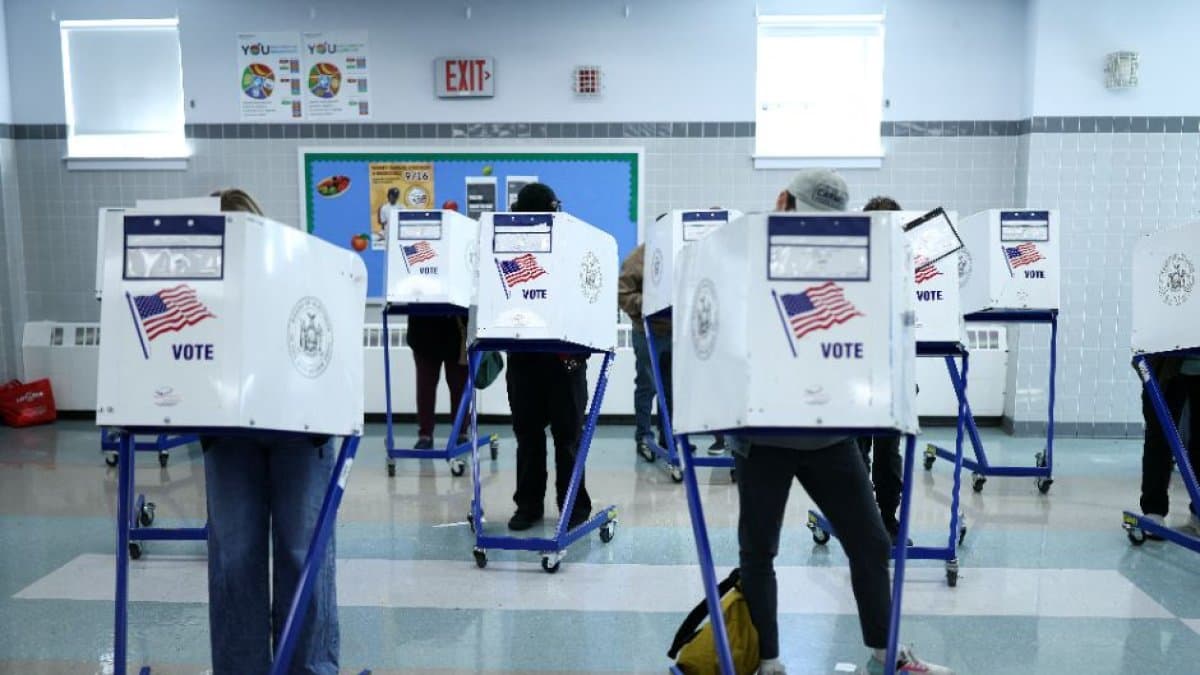







One by one: The twelve races that will determine who controls the Senate
Currently, Republicans hold a 53-to-47 majority, so Democrats need to gain 4 seats to take control of the Senate.


A year ago, the Senate electoral map for 2026 looked like an easy win for the Republicans. With popular incumbents and a relatively favorable electoral map, it seemed logical to assume they would have no trouble retaining their majority, and perhaps even expanding it. However, just days before the midterm elections, the Senate's future seems up in the air, and twelve key states will decide it.
Currently, Republicans hold a 53-47 majority, so Democrats need to gain four seats to take control of the Senate.
For Donald Trump, the Senate is key. With polls predicting a Democratic victory in the House of Representatives, losing the Senate would mean facing a hostile Congress during his final years in the White House. His nominations and a potential Supreme Court vacancy would stall.
On the other hand, Democrats are counting on the "blue wave" they've hoped for to be strong and sweeping enough to win in Republican states such as Kansas, Iowa, Ohio, and Mississippi.
In this context, these twelve races will determine which party retains control of the Senate. Overall, Democrats hold four and Republicans hold eight.
Michigan: Is El-Sayed too extreme for the state?
Michigan is seen as Republicans' best chance to take a Senate seat away from the Democrats. Following Gary Peters' retirement, Democrats nominated Abdul El-Sayed, while Republicans nominated former Congressman Mike Rogers.
El-Sayed, a physician and former director of the health departments in Detroit and Wayne County, represents the most progressive wing of the Democratic Party. If elected, he would become the first Muslim senator in the country's history.
The Republicans and Rogers' campaign are attacking him for his positions, including abolishing Immigration and Customs Enforcement (ICE), as well as his political ties to Hasan Piker. Piker, who campaigned alongside El-Sayed during the primaries, came under heavy criticism for saying in 2019 that the United States "deserved" 9/11, a statement he later retracted. El-Sayed, who initially avoided condemning those remarks, later said it was "a foolish statement" and that he does not believe 9/11 was justified.
In addition, in an interview with CNN, El-Sayed accused Israel of committing "genocide" in Gaza and of being an "apartheid" state.
For his part, Rogers is a former FBI agent, a member of the House of Representatives, and a Republican candidate for the Senate in 2024. He has focused his campaign on positioning himself as Michigan's "most normal" candidate, in contrast to El-Sayed's more radical stances.
One of the main points of his presentation is the chapter titled "Democrats for Rogers." The campaign has recruited dozens of Democrats, many of them African American, to speak out publicly in support of Rogers. The videos have had a strong impact on social media.
Even Democrat Haley Stevens, who lost the primary to El-Sayed, praised the Republican campaign's work, particularly in the Detroit area.
The polls show El-Sayed ahead of Rogers.
North Carolina: The toughest battle for the GOP
With his 2020 victory, Thom Tillis overcame the "single-term curse" that had plagued his seat in North Carolina, as no incumbent had been reelected since 1996, when Jesse Helms won reelection. Given this history, Tillis had already filed the necessary paperwork to run again in 2026.
However, he announced that he would not seek reelection after publicly clashing with Trump. The president then endorsed Michael Whatley, former chairman of the Republican National Committee (RNC).
Meanwhile, Senate Democrats recruited the popular former governor Roy Cooper, who has never lost a state election and has a strong track record in rural counties.
Ever since this matchup was confirmed, Cooper has led in all public polls.
Texas: The Democratic dream
Following the disappointment with Beto O'Rourke in 2018, Democrats suffered major setbacks in Texas in recent election cycles. However, they regained hope thanks to three factors: a favorable national climate, the candidacy of James Talarico, and the fact that their opponent is Ken Paxton, the state attorney general, whom they view as a vulnerable candidate even though Texas has not elected a Democrat to the Senate since 1988.
Senator John Cornyn, who has held office since 2003, was defeated by Paxton in the Republican primary. Trump endorsed Paxton a week before the primary and has defended Paxton as one of the most effective and conservative attorneys general in the country.
Talarico, a state representative for the Austin area, defeated Congresswoman Jasmine Crockett in the Democratic primary. Looking ahead to November, Talarico is appealing to moderates and, above all, to Republicans who voted for Cornyn in the Republican primary. According to a recent Fox News poll, 29% of Republicans who do not consider themselves "MAGA" would vote for Talarico.
Both President Trump and the Republican leadership have spent millions and millions of dollars in this race. Adding to that financial effort is Elon Musk, who has become one of the largest donors in these midterm elections.
The polls show a neck-and-neck race, with both candidates within the margin of error. Looking ahead to 2028, a Democratic victory in Texas would give Democratic voters across the country a major morale boost.
Maine: Susan Collins seeks to defy the odds again
Susan Collins is seeking not only her sixth term in the Senate representing Maine, but also to pull off another surprise on election night. Although Collins was not expected to be reelected in 2020, she defied poll predictions and won by nine percentage points. Six years later, Democrats are back in the running for her seat.
To that end, they nominated Troy Jackson, who became the nominee following the withdrawal of Graham Platner, who stepped down from the race in July. Jackson spent many years in the Maine Legislature and served as president of the state Senate. The Democrat represents the party's most progressive wing, and his proposals include "Medicare for All" and abolishing U.S. Immigration and Customs Enforcement (ICE).
In the final stretch of the campaign, polls show a close race with the difference falling within the margin of error.
Alaska: Dan Sullivan could lose because of Dan Sullivan
Dan S. Sullivan, U.S. Senator from Alaska since 2015, is seeking reelection under unusual circumstances. In addition to competing against former Democratic Congresswoman Mary Peltola, there is another candidate with the same name. That candidate is Dan J. Sullivan, a retired teacher from Petersburg, a small fishing community.
The controversy over the former teacher's candidacy intensified a week before the election. The New York Times published text messages that, according to the newspaper, show members of Peltola's campaign discussing recruiting people with the same name as the senator, even searching for the retired teacher.
Before the report's release, Mary Peltola's campaign and the Democratic Senatorial Campaign Committee (DSCC) denied any involvement in recruiting Dan J. Sullivan. Sullivan also denied having ties to the Democratic campaign.
Alaska's electoral system differs from that of the rest of the country. Since 2022, the state has used an open primary system and ranked-choice voting for all candidates, regardless of party. The four candidates with the most votes advance to the November election.
In the general election, voters do not mark a single name, but rather rank candidates in order of preference. They mark a first choice, a second, and a third. If no candidate receives more than 50% of the first-choice votes, the candidate with the fewest votes is eliminated and their votes are transferred to each voter's second choice, and so on until someone receives more than 50%.
The key point is that if a voter mistakenly checks the box for the other Sullivan, that vote will not necessarily go to the senator, since it will depend on what the voter checks next.
In addition, Alaskans are also voting on a referendum to repeal the open primary and ranked-choice voting system, the second attempt following the failure in 2024
Georgia: Jon Ossoff is on track for re-election with an eye toward 2028
Jon Ossoff didn't expect this scenario. He was elected in January 2021 after defeating incumbent David Perdue by 1.3 percentage points in the runoff election. Six years later, he is on track, sailing toward reelection in Georgia.
His opponent will be Mike Collins, a member of the House of Representatives and author of the Laken Riley Act. He secured the Republican nomination after defeating former coach Derek Dooley in a race that pitted Governor Brian Kemp against President Trump.
Ossoff, a serious, low-profile candidate, has demonstrated a great ability to raise funds. According to data from the Federal Election Commission (FEC), he is far ahead of Collins in this regard.
Since the Ossoff-Collins race was confirmed, polls have favored the Democratic senator.
The outcome could even affect the upcoming presidential election. Looking ahead to 2028, several political analysts consider Ossoff to be one of the names to watch, whether as a presidential candidate or a running mate.
Ohio: Sherrod Brown seeks to return to D.C.
In Ohio, Secretary of State Jon Husted will seek his first full term in the Senate. In 2025, Governor Mike DeWine appointed the then-lieutenant governor to replace JD Vance after he took office as vice president. The Republican will face off against Sherrod Brown, a former senator and the Democrats' "star recruit" for this race.
Brown represented Ohio in the Senate from 2007 to 2025. He lost his last reelection bid in 2024 to Republican Bernie Moreno and will now seek to return to Capitol Hill amid the prospect of a possible "blue wave." The winner will serve out Vance's remaining term until January 2029.
One key factor in this election has been the candidates' positions on data centers. Brown made expanding these facilities one of the main pillars of his campaign against Husted, whom he links to the industry's growth during his time as lieutenant governor.
Although Trump won the state comfortably in 2024, the polls predict a close race.
Minnesota: A Republican upset?
Minnesota is another race that was not expected to be competitive. The last Republican victory in the state was in 2006, when Tim Pawlenty was re-elected governor. However, that streak could end in 2026.
Tim Scott, chairman of the Republican National Senatorial Committee (NRSC), has said several times that Minnesota could be the surprise of this midterm election.
The reason? Fraud scandals in state programs that have rocked Minnesota in recent months, damaging the Democratic brand statewide. Even Governor Tim Walz decided not to run for reelection this year.
In this context, Governor Tina Smith also stepped down, and Lieutenant Governor Peggy Flanagan won the Democratic nomination. Flanagan is one of the state's most prominent progressive figures.
Meanwhile, the Republicans nominated Michele Tafoya, a former NFL sports commentator with strong name recognition. Tafoya presents herself as a moderate Republican who can work with both parties. She has also made the fight against fraud a central focus of her campaign.
To drive this point home, Tafoya's campaign released an ad titled "Classroom," in which an elementary school teacher explains to the children that fraud has no consequences in Minnesota.
"We teach our kids about consequences. Peggy Flanagan let fraudsters steal hundreds of millions of dollars from you," Tafoya says at the end of the ad.
On the other hand, Flanagan has tried to link Tafoya to President Trump, who lost Minnesota by four percentage points in 2024.
The latest polls show Flanagan leading Tafoya by between three and ten points.
Kansas: A Democratic upset?
Just as Republicans hope to defy all predictions in Minnesota, Democrats are counting on doing the same in Kansas, a conservative state at the federal level but with a Democratic governor.
Republican Roger Marshall won his first term in 2020 by a margin of more than 11 percentage points. However, he faces a close race against Democrat Adam Hamilton, a Methodist pastor and founder of the Church of the Resurrection, the largest United Methodist congregation in the country.
Meanwhile, Marshall has described Hamilton as too "woke" and extreme for Kansas's values. Hamilton has said that Marshall would even qualify as "woke" by Jesus Christ himself.
Although Kansas is a conservative state, polls predict a scenario of a dead heat, with both candidates trading the lead, though always within the margin of error.
The last Democrat elected to the Senate in Kansas was George McGill, who was elected in 1932.
Iowa: Ashley Hinson vs. Josh Turek
In Iowa, Senator Joni Ernst chose not to seek reelection, leaving an open seat that appeared safe for the Republican Party. Congresswoman Ashley Hinson earned Trump's early endorsement and won the nomination without a hitch.
A former television reporter, Hinson has also emerged as an independent voice; she even questioned the president'sTdecision to allow imports of Russian diesel in an effort to keep fuel prices in check.
Her opponent is Josh Turek, a state legislator and two-time Paralympic gold medalist in wheelchair basketball. Turek has campaigned as a moderate and has highlighted in his ads the times he voted with Republicans in the state Legislature.
As for the polls leading up to November 3, both candidates are within the margin of error.
New Hampshire: Will the Sununu surname be enough?
In New Hampshire, John Sununu is running for re-election to the Senate. Of course, the Sununu name carries a lot of weight in the state, and this time around he is seeking to regain his former seat.
Sununu, 61, belongs to one of New Hampshire's most prominent political families and represents a more traditional and moderate wing of the state's Republican Party. He is the brother of former New Hampshire Governor Chris Sununu, and the son of John H. Sununu, also a former governor and chief of staff to George H.W. Bush.
The Republican served as a New Hampshire senator from 2003 to 2009, but lost his 2008 reelection bid to Jeanne Shaheen, whose seat is now open.
For their part, the Democrats nominated Chris Pappas, a Democratic representative from the 1st congressional district who is also considered a moderate. Interestingly, in 2022, he won reelection to the House of Representatives after defeating Karoline Leavitt, who was 25 years old at the time.
Pappas has consistently topped the polls and hopes to retain the seat for the Democrats by defeating an opponent from one of the state's best-known political families.
Mississippi: Democrats' farthest-reaching dream
The last seat on the list is that of Mississippi. There, Republican Senator Cindy Hyde-Smith, who has held the seat since 2018, was expecting a smooth reelection. Even Donald Trump won the state by more than twenty points in 2024. However, Democrats have other plans for 2026.
Somewhat surprisingly, the race has become more competitive than expected, thanks to Democrat Scott Colom, whose campaign has generated enthusiasm among Democrats across the country. However, Hyde-Smith has led in all public polls.
The last time a Democrat won a Senate election in the state was in 1982, when John Stennis defeated Haley Barbour.
🛠 Do you think there is an error in this article?
Recommendations






LATEST